

Overview of Nguyen Dynasty Eunuchs
Eunuchs played a significant role in the imperial administration of Vietnam’s Nguyen Dynasty (1802–1945). These individuals, castrated at a young age, served in various capacities within the royal court, particularly within the Hue Imperial Citadel.

While they were primarily attendants to the emperor and his family, their influence extended beyond simple servitude, as they often acted as intermediaries between the ruler and the outside world.
Despite their importance, their contributions have largely been overlooked in historical narratives. Let’s reveal the lives and secrets of the Nguyen Dynasty’s enunuchs in this detailed and informative article with Bee Bee Travel.
What Are Eunuchs?
Eunuchs are men who have been castrated, often before puberty, rendering them unable to father children. In many ancient cultures, including China, Persia, and Vietnam, eunuchs were employed in royal courts as trusted servants.
Their inability to establish family dynasties made them less of a political threat, making emperors feel secure in entrusting them with confidential duties and positions of power. Over centuries, they evolved from mere attendants to powerful political figures who wielded significant influence within the court.
Why Did Ancient Emperors Favor Eunuchs?
Ancient emperors relied on eunuchs for several reasons:
- Loyalty and Dependability: Without familial ties or aspirations for hereditary power, eunuchs were considered more loyal to the throne.
- Confidentiality: They had access to the most intimate aspects of court life, including serving the emperor’s consorts and handling state secrets.
- Intermediary Roles: As they worked closely with the emperor, they often acted as messengers between the ruler and the bureaucracy, controlling the flow of information.
- Management of the Imperial Harem: Since eunuchs could not father children, they were trusted to oversee the emperor’s wives and concubines, ensuring legitimacy in royal succession.
What Was the Eunuch’s Work in the Citadel?
Within the Nguyen Dynasty’s Imperial Citadel in Hue, eunuchs took on a variety of responsibilities:
- Palace Administration: Eunuchs managed the emperor’s private quarters, handling household affairs, ceremonial preparations, and even financial matters.
- Guards and Attendants: They safeguarded the inner court, ensuring the security of the imperial family.
- Religious and Ritual Duties: Many eunuchs served in temples and religious institutions, maintaining altars and conducting imperial ancestor worship ceremonies.
- Messengers and Advisors: Some eunuchs had close relationships with the emperor and were trusted to convey messages or offer counsel on state matters.
- Record Keeping and Archival Work: A select few were literate and responsible for managing imperial records, decrees, and important documents.
The Number of Eunuchs in the Nguyen Dynasty
Although there is no exact record of the total number of eunuchs who served during the Nguyen Dynasty, historical sources suggest that their numbers fluctuated depending on the period. Under Emperor Gia Long (1802–1820), the number of eunuchs was relatively small, as he followed Confucian traditions that discouraged reliance on them.
However, by the reign of Emperor Minh Mang (1820–1841), their presence in the court had increased significantly. Some estimates suggest that there were a few hundred eunuchs serving in various capacities during the peak of the dynasty. As Vietnam modernized under later emperors, the role of eunuchs declined, and their numbers dwindled until the Nguyen Dynasty’s fall in 1945.
Where Did They Bury the Nguyen Dynasty Eunuchs?
When they became old or fell ill, they were not allowed to remain in the imperial palace. Upon the completion of their service, they received pensions from the royal court and relocated outside the imperial city, residing in the Cung Dám Viện, or the “Eunuch Department.”
To combat loneliness, many eunuchs formed brotherhoods or adopted children. Some even chose to marry, despite being unable to have children. They often wed elderly women as companions in their final years. A few fortunate eunuchs were able to return home to live with relatives.
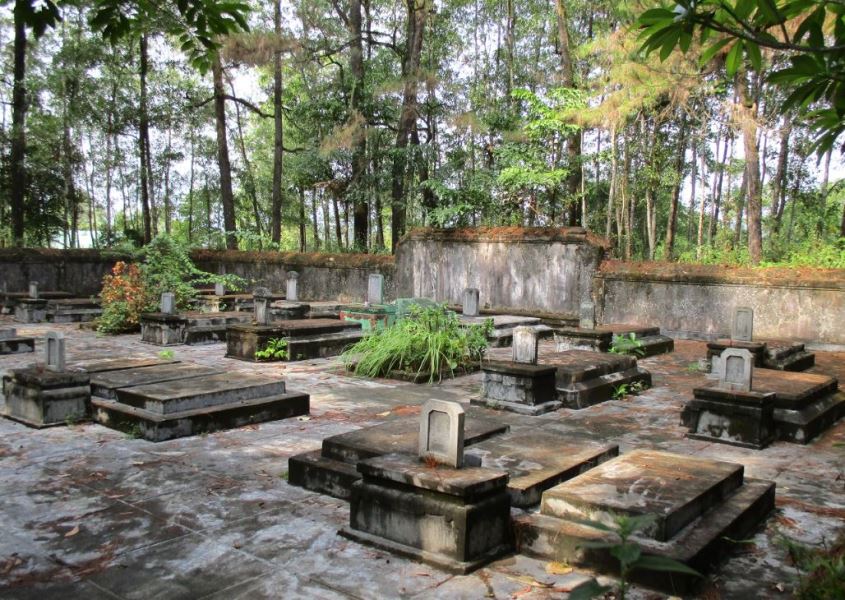
Concerned about being alone in death, eunuch Châu Phước Nang took the initiative to restore Từ Hiếu Pagoda, an ancient temple located about 5 kilometers from Hue, during the reign of Emperor Thiệu Trị (1807–1847). He selected this site as his final resting place, and from then on, eunuchs who contributed to the pagoda were granted burials there and honored through worship rituals.
Within the grounds of Từ Hiếu Pagoda, the eunuch cemetery is situated on the left side, approximately 30 meters from the main temple. Spanning nearly 1,000 square meters, the cemetery contains 23 graves arranged in three rows. At the center, a stone stele commemorates the contributions of these eunuchs to the Nguyen Dynasty.
Conclusion
Eunuchs played an essential yet often overlooked role in the Nguyen Dynasty, serving as trusted aides, administrators, and intermediaries within the royal court. Their loyalty and close proximity to the emperor granted them significant influence, yet their lives were marked by sacrifice and social isolation.
Although their numbers declined towards the end of the dynasty, their contributions to the Nguyen court remain an intriguing chapter in Vietnamese history.
