
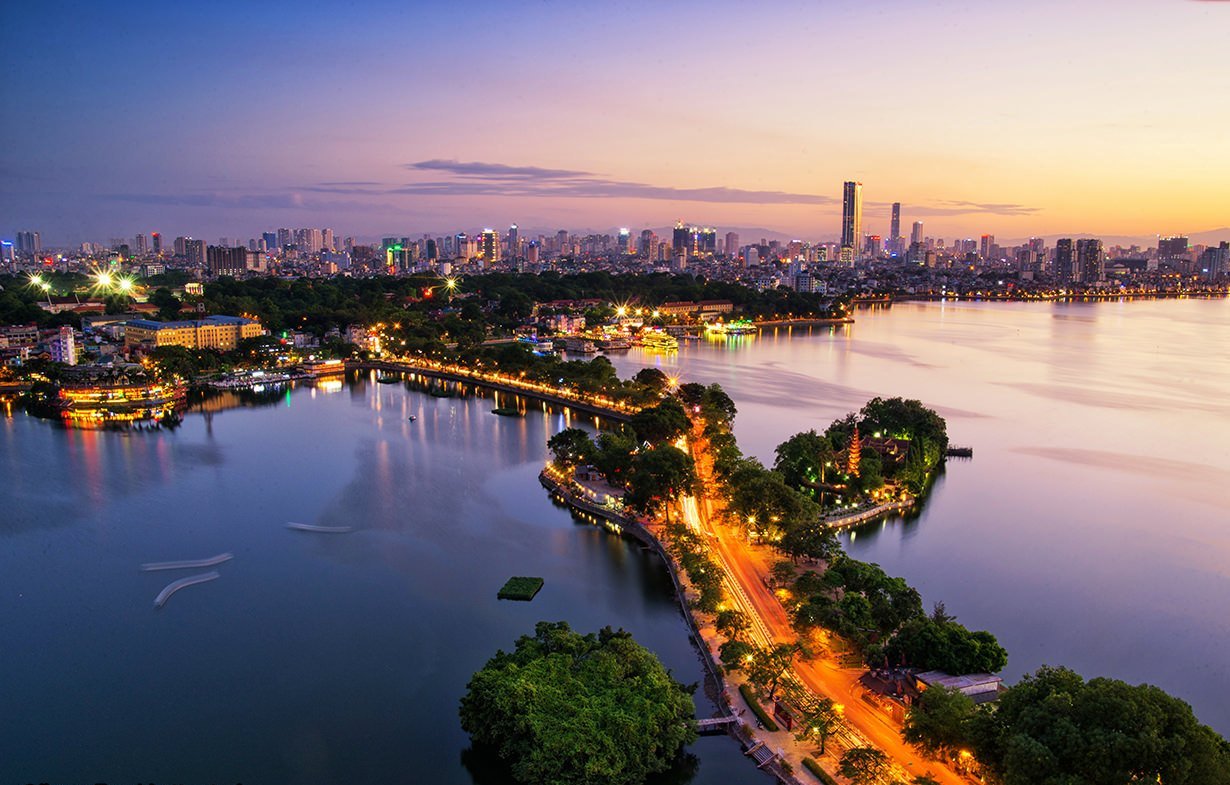
This article is to give you, travelers from United States, a guide to visit the Far East country called Vietnam. An increasingly vibrant tourist destination, this country will continue to break barriers and dispel preconceptions. From lush jungle terrain to beautiful coastline, cosmopolitan cities to friendly hamlets, Vietnam offers travelers quite the assortment of diversions. I suggest trying to spend a few weeks. After short-but-amazing 3-week exploring Vietnam, the information I provide below hopefully gives you an overview of Vietnam as well as some useful tips to tactically plan your visit to this beautiful part of the world!
Vietnam is HUGE!
Official name: Socialist Republic of Vietnam.
Population: 92,7 millions.
Area: Vietnam is 329,560 square kilometers or 127,244 square miles. That’s a bit smaller than California (423,970 square kilometres, but as you can see Vietnam is considerable longer).

It takes over 30 hours to ride a train from Ha Noi to Ho Chi Minh (1072 miles). By bus, maybe 50 hours. It’s not unlike a trip from New York to Los Angeles.
If you’re doing the whole North to South trip, give yourself three weeks or be prepared to rush, or fly. There is so much to see between Hanoi and HCMC. You don’t want to watch it whizz by your window. Don’t underestimate Vietnam’s size and give yourself time to explore. If you only have a week or two, stick to either the Northern, Central or Southern regions. Don’t try to force it all down in one short fling.
Geography
Vietnam is located on the eastern seaboard of the Indochine Peninsula, sharing common borders with China to the North, and Laos and Cambodia to the west. To the east and south lies the East Sea. Mountains and hillis covers four-fifths of Vietnam’s territory with the Truong Son Range stretching over 869 miles. Mount Fansipan (5,250 feet above the sea level) is the highest peak on mainland South East Asia.

The most populated areas in Vietnam are the Red River Delta and the Mekong Delta, which feature fertile soil led by a dense of river network. The country has a long coastline of 2025 miles running from Mong Cai in the North to Ha Tien in the SouthWest. Vietnam’s territorial waters in the Eastern Sea extend to the East and Southeast, including the continental shelf, island and archipelagoes. There is a group of around 3,000 islets belonging to Vietnam in the Tonkin Gulf, including Ha Long Bay, Bai Tu Long Bay, Cat Hai, Cat Ba and Bach Long Vy island. Farther in the Eastern Sea are Hoang Sa Archipelago (Paracel island) and Truong Sa Archipelago ( Spartly island). To the West and the SouthWest, there are groups of islands including Con Son, Phu Quoc and Tho Chu.
Resources
Minerals: coal, iron, aluminum, tin and oil.
Agriculturea and forestry products: rice, maize, sweet potatoes, peanuts, soy beans, rubber, lacquer, coffee, tea, tobacco, cotton, coconut, sugar cane, jute and tropical fruit.


Climate
Vietnam’s climate varies a great deal from North to South. Northern Vietnam has four distinct seasons: spring, summer, autumn and winter. In the North, summers are warmth while winters are cool and misty.

Southern Vietnam is warm all year round, with temperatures typically varying by just 5 to 9 Fahrenheits.

Tropical monsoon occur from May to November in the North and South and from September to January in the Central Region, including Hue, Danang and Hoi An cities.
Hue, the ancient capital of Vietnam, a great place to learn about Vietnam history.
Tip: Best time to travel to the country is from February to June since the weather is stable all around Vietnam and temperatures is consistent from North to South, around 80 – 95 °F.
Smart Guide to Pricing in Vietnam
In Vietnam, be prepared to bargain
To give you an idea of where to start, I suggest the following price:
Transport

Use Uber or Grab in cities of Hanoi, Saigon, Danang with easy catch even when you do not have a local phone number in Vietnam, you can pay by cash once finish a ride.
In city like Hue, Hoi An and others, taxi should be 14,000 VND/ kms and motorbike is 10,000 VND/ kms.

Grooming
Shoeshiners is easily found on the street of Hanoi and Ho Chi Minh with a charge of 10,000 VND/ pair.
Hairwash 25,000 VND
Street haircut 30,000 VND
Street-side laundry 15,000 VND – 22,000 per kilo ~ 60 cents – $1 per 35 oz of clothes.
Rain Gear
Plastic rain ponchos 10,000 VND for a thin and 20,000 VND for a thick one.

Food

Pho ( Northern Style Beef Noodle Soup): VND 40,000 per bowl
Banh mi ( Vietnamese stuffed baggette): VND 10,000 – VND 20,000 per banh mi
Bun Bo Hue ( Hue style beef noodle): VND 30,000 per bowl.
Hu Tieu ( Southern Style Beef Vermicelli Soup): VND 15,000 – VND 20,000 per bowl.
Stomach illness is common among first-time visitors. Soup that has been sitting too long is often the culprit.
Try to eat only at restaurants that are busy, as their ingredients turn over more and they are likely to keep the gas on all day.
To save you time to explore cuisine in each city, there are many companies who do great food tour. Look them up for a delicious, safe and fun food experience.
Check out my experience about Bun Bo Hue during my food tour in Hue City.
History
Vietnam’s history can be complicated to understand and can roughly be devided into the following periods:
The pre-history: From circa 400,000 years (Paleolithic) to 4,000 years (Neolithic) ago, cultures in the area included Son Vi, Hoa Binh, Bac Son, Ha Long, and Hoa Loc.
Proto-history: According to legends, Vietnam originated in the seventh century BC when the Hung Kings founded Van Lang. In the third century BC, King An Duong Vuong named founded Au Lac and ruled until 179 B.C.
Chinese Occupation: Vietnam was occupied by China from the first to the tenth century A.D
Monarchy: Kings reigned from 968 to 1945.
Independence: The Democratic Repubilic of Vietnan was founded after the 1945 August Revolution, when President Ho Chi Minh declared independence. The Socialist Republic of Vietnam has been the official name since 1976.
Avoid “Packaged” Day Tours As Much As Possible
It’s tempting, because they are easy, and advertised all over the backpacker districts. Trips to the DMZ, Hue City Tour, the Cu Chi Tunnels, Mekong Delta, the My Son ruins….
These “tours” cost as low as aprox. $10 – $12/day, but will make unnecessary stops all over the route to give you the chance to spend money at their friends’ restaurants, gift shops, bathrooms, etc. It’s a big fat waste of time.
Spend the extra money to hire a private car or book a tour that goes a bit easier at certain attraction. Once you pay the money and get on the cramped little “bus” you are basically a prisoner for a day. “It was OK” is generally as good a review as these day trips will get. There are so many companies out there doing a better job. Of course, you get what you pay for! So look up a bit harder to find yourself a perfect tour.
Ethnic Groups
There are 54 ethnic groups living in Vietnam. The Viet or Kinh people account for 88% of Vietnam’s population and are mostly concentrated in the lowlands. Most of the country’s ethnic minority people live in the mountainous areas. Major group include the Tay; the Nung; the Thai; the Muong; the H’Mong; the Dao; the Hoa; the Khmer; the Bana; the Giarai; and the Ede.

The Religions
Major spiritual influences in Vietnam include Buddhism, Taoism, Confucianism, and native religions (Ancestors, Mother Goddess Worship). Christianity arrived late in the 18th century and now has the second largest following, after Buddhism. Other religions practiced include Islam and Cao Dai, with higher concentration in the South.

You Can Be Stylish, But Dress Conservatively
Young and colorful, Vietnam is an increasingly stylish place. Don’t think that you have to dress like a hippie to avoid appearing posh. Bring your nice clothes. However, do as the locals do and be moderate. There has been a conservation law recently that banned tourists who shows knees, tummy, cleavage, and backside of your body when entering ancient or religious monuments.
I know, it’s hot. But, notice that locals don’t wear bikinis on the street, or walk around with no shirt showing off their tattoos? Please do.

Vietnamese language and scripts
More than 80% of the population speak VIetnameses or Kinh, the national language. Ethnic minorities have native languages. Three scripts have influenced Vietnam’s history: Han (Classic Chinese) ideograms were used untik the begining of the 20th century. The Nom script, created bertween the 11th and 14th century is based on the Han script. European missionaries in the 17th century used to Roman alphabet to record the Vietnamese language and created Quoc Ngu script. After independence in 1945, Quoc Ngu was developed and used as the official national language.

Busines hour
Government office and museums open early, around 8 a.m and close between 5 pm and 5:30 pm.
Currency
The currency in Vietnam is the dong VND which currently trades at about VND 22,700 to a US dollar. Credit card acceptance, especially for visa is speaking in higher-end hotels, rstaurants and shops in big cities.
Pay attention to your Vietnam Dong

Can you see a difference between a 500,000 VND ($22) and a 20,000 VND ($0.9)?
Hotels and registration
There is a wide range of accommodation available in Vietnam’s major cities. Hanoi and Ho Chi Minh feature a choice of five star hotels whiles guests house and mini hotels offer no-frills rooms for around 600,000 VND ( $28). As hotels and private hosts must register your presence with the police, you’ll be expected to hand over your passport.
Hotel Recommendation from North to South
Hanoi : Antique Hotel, modern classic decor, $35 – $55/ room/ night.
Halong Bay: Imperial Junk, $60-$80/ room/ night/ person.
Sapa: Sapa Eden Hotel, $30-$40/ room/ night.
Hue: Le Perle Hotel, $28-$35/ room/ night.
Hoi An: La Residencia Hotel, $40-$60/ room/ night.
Ho Chi Minh City: Luxe Hotel, $40-$60/ room/ night.
Safety
While Vietnam is one of the safest coutnries in ASia, you should take care with own possessions. Secure your valuables, documents and credit cards in your hotel’s safe.
If you choose to drive a motorbike or ride a bicycle, by law you must wear a helmet.
Check your phone and possession when leaving a taxi, train or dining table.
Telecommunications
It is easy to purchase a phone number with a charge of $5 for calling, text and 3G service at the airport. Many hotels especially up-markets ones adds extra fees. Check the rates before dialing. One long-distance service offers a flat fee of around VND 4,000 per minute to 50 countries. Faxes can be sent from hotels, business centers and post offices. Many free wifi spots can be found around Hanoi and Ho CHi Minh City, including hotels, cafes, and restaurant.
Vietnamese people are extremely happy and hospitable!
Time and time again, I hear travelers complain that they were treated like “walking ATM machines” throughout Vietnam. Generally, these travelers largely stuck to the aforementioned “backpacker trail” and didn’t study-up on prices before going in.
I’ve had nothing but extreme hospitality and kindness outside of the tourist areas. Happy school children waving “hello”, invitations to karaoke and beer in the evening, free snacks on the “hard seat” trains…the list goes on. Just like everywhere else, people are great in Vietnam. Don’t let the touts and scammers sour your opinion.
